Updated: October 21, 2026
What Is a Bagasse Bowl? Materials, Uses and Buyer Checks
A Practical Introduction to Sugarcane Fiber Bowls for Restaurants, Foodservice Distributors and Wholesale Buyers
A bagasse bowl is a molded-fiber food container made primarily from processed sugarcane residue. It is commonly used to package or serve rice, noodles, salads, takeaway meals and other prepared foods.
But here's something buyers often overlook: the word “bagasse” tells you where the main fiber comes from. It doesn't tell you everything about the finished bowl.
Two bowls may look almost identical, yet use different barrier treatments, have different rim shapes or perform differently with hot, oily or moist foods.
For restaurants, catering companies and distributors, the important question is not simply, "Is this a bagasse bowl?"
It's whether a particular bowl, with its actual construction and matching lid, is suitable for the food and service conditions you have in mind.
This guide explains what bagasse bowls are made from, where they are used, and what to verify before selecting a product for bulk purchasing.
What Is a Bagasse Bowl?
A bagasse bowl is a foodservice container made by processing sugarcane fibers into pulp and forming that pulp into a bowl-shaped article.
Bagasse itself is the fibrous residue left after sugarcane stalks are crushed to extract their juice. This agricultural byproduct can be processed into a useful fiber source for molded packaging.
Unlike a conventional plastic bowl formed from molten polymer, a molded-fiber bowl gets much of its structure from a network of plant fibers shaped and consolidated during production.
The finished product may be available in different sizes, depths, shapes and material configurations.
Some designs have a relatively simple fiber structure. Others incorporate barrier treatments or are supplied with separate lids or films.
Buyers can explore bagasse bowls to compare product formats, but the final selection should always be based on actual specifications and intended use.
How Is a Bagasse Bowl Made?
Manufacturing generally begins with cleaning and preparing sugarcane fibers for pulping.
The processed pulp is distributed into forming tools, where water is removed and the material takes the shape of a bowl.
Pressing, drying and finishing help establish the bowl's structure, surface, rim and dimensions. Trimming and inspection follow as required by the manufacturing process.
Details such as fiber distribution, rim geometry, wall uniformity and dimensional consistency can affect performance in daily foodservice operations.
A bowl with an uneven rim, for example, may create difficulties when an operator tries to attach a matching lid.
That's why a buyer should evaluate the finished article rather than assuming every product made from sugarcane fiber will behave identically.
What Is a Bagasse Bowl Made Of?
A completed bagasse bowl can have more than one material component.
Understanding these components helps buyers evaluate food compatibility, supporting documentation and end-of-life claims.
Sugarcane Fiber Base
The bowl's main body is formed from processed sugarcane fiber.
This molded-fiber structure gives the bowl its shape and provides a foundation for holding food.
However, the product formulation and manufacturing process may include other ingredients or treatments. The exact finished construction should be confirmed with the supplier.
The presence of a plant-based fiber does not, by itself, establish that the complete article is plastic-free or suitable for every food-contact application.
Coatings and Barrier Layers
Some bagasse bowls incorporate barriers to help manage moisture, oil or other food-contact demands.
These may involve different coating chemistries or film structures.
For example, PLA, PBS, PE and water-based barrier systems have different material characteristics and possible disposal implications.
A water-based coating is not automatically free of synthetic polymers, and a bio-based component does not automatically establish that the entire product is plastic-free.
Buyers should review the actual construction, not just the label.
Warmpack's bagasse coatings and barrier options explains the main differences and the questions buyers should ask.
Lids and Sealing Films
Many applications require more than an open bowl.
Depending on the product design, the bowl may be paired with a molded-fiber lid, transparent PET or PP lid, or a compatible sealing-film system.
Each component may have its own food-contact conditions, temperature limitations and disposal requirements.
Think of the bowl and closure as two parts of the same packaging system. A suitable bowl with an unsuitable lid can still result in poor performance.
The complete configuration must therefore be assessed together.
Where Are Bagasse Bowls Used?
Bagasse bowls are available in formats intended for a variety of foodservice applications.
They can be considered for quick-service restaurants, cafeterias, catering programs, takeaway counters and selected prepared-food operations.
However, different foods place different demands on the container.
A chilled salad and a hot curry may both be served in bowls, but they do not create the same moisture, heat or closure conditions.
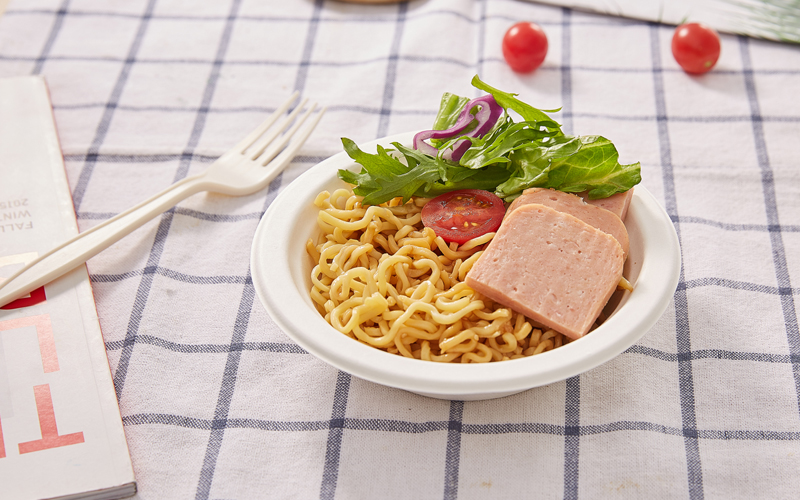
Rice and Noodle Meals
Rice bowls, pasta and noodle dishes often combine solid ingredients with sauces, steam or hot fillings.
For these applications, buyers should consider the usable capacity, bowl depth, weight of the meal and expected holding period.
A nominal capacity does not always equal the practical filling volume.
If the bowl will be closed, sufficient headspace must remain for toppings, steam and lid engagement.
The most useful test is therefore a complete meal packed to its normal serving portion—not an empty bowl inspection.
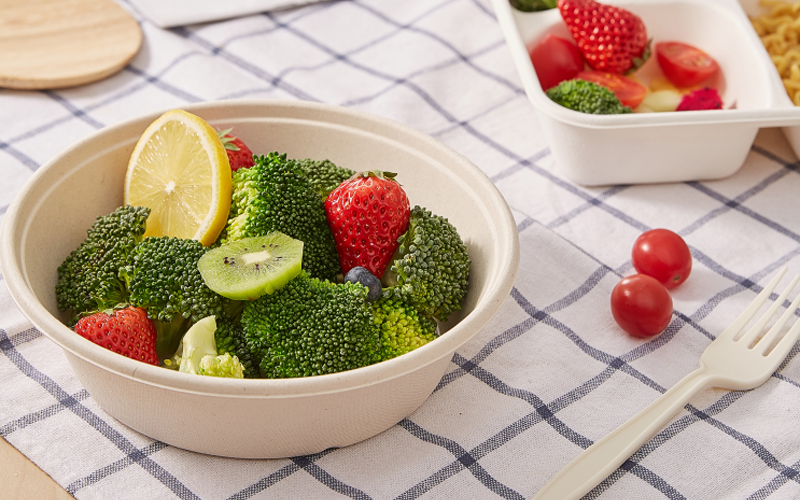
Salads and Chilled Foods
Salads, grain bowls and chilled prepared foods may benefit from packaging that supports presentation and convenient handling.
When visibility matters, some buyers consider compatible transparent lids.
The important checks include actual food-contact conditions, moisture from dressings, condensation and whether the lid provides enough clearance for the ingredients.
For refrigerated or chilled distribution, the bowl and its closure should be reviewed together.
A product suitable for one chilled food should not automatically be assumed suitable for every cold-chain application.
Soups and Saucy Foods
Soup, curry, gravy and oily dressings create more demanding contact conditions.
A container holding a dry meal successfully may behave differently when filled with liquid or oil-rich food.
Potential issues include moisture penetration, loss of rigidity, external dampness and leakage around the closure.
Buyers should define the food type, normal filling conditions, holding time and transport method before selecting a bowl.
Where a barrier is required, the choice must be supported by the finished product's specifications and relevant testing.
Foodservice Applications and Buyer Checks
The following table is a selection guide, not a claim that every Warmpack bowl is approved for each application.
| Foodservice Use | What Varies | What Buyers Should Verify |
| Rice or noodle meals | Portion weight, steam, sauce and holding time | Usable capacity, rigidity, food clearance and closure |
| Salads and chilled foods | Dressing, condensation and storage conditions | Moisture performance, lid material and chilled-use suitability |
| Soups and sauces | Liquid, oil, temperature and contact duration | Barrier structure, leakage, rim performance and applicable food-contact conditions |
| Delivery or takeaway meals | Movement, stacking, steam and journey duration | Filled-pack closure, handling, deformation and transport performance |
For restaurants handling several menu categories, testing the actual food is more reliable than assuming one material description covers them all.
What Should Buyers Verify Before Use?
Before approving a bagasse bowl, define the job the product must perform.
Start with your menu, not a marketing claim.
The same bowl may encounter different service conditions when used for a short dine-in meal, a delivery order or a chilled prepared-food program.
Food Type, Temperature and Holding Time
Record the characteristics of the intended food.
Is the meal dry, moist, acidic, oily or primarily liquid? Will it be filled warm or cold? How long will it stay inside the bowl before consumption?
Also consider whether staff will stack filled bowls or place them inside delivery bags.
These details affect the performance requirements you should discuss with the supplier.
If a bowl will be used for several menus, test representative conditions—including the most demanding normal application.
Warmpack's guide to testing bagasse food containers before buying explains how to organize sample comparisons involving food, moisture, handling and delivery.
The goal is to establish suitability for a clearly defined application, rather than declare that a bowl is universally heat-resistant or leakproof.
Microwave, Oven and Freezer Claims
Can a bagasse bowl go in the microwave?
The answer depends on the exact finished product and its documented intended use.
A manufacturer may have assessed a particular bowl for specified microwave conditions. That information should identify the relevant product and explain any restrictions.
The bowl base, coating, lid and sealing film may not have identical heating suitability.
Do not assume that short heating cycles or a particular microwave power percentage are universally safe.
Oven use requires separate consideration. Microwave suitability does not establish that a bowl can safely withstand conventional oven conditions.
The same principle applies to freezing.
A product intended for frozen meals should be assessed with its contents, closure and expected freezing, thawing and reheating sequence.
If the supplier has not confirmed an intended use with appropriate evidence, do not treat the product as approved for that use.
Bagasse Bowl Verification Checklist
| Pack Component or Claim | Information to Request | Why It Matters |
| Bowl construction | SKU, fiber formulation description, product version and specifications | Identifies the exact finished article |
| Barrier layer | Coating or film type and applicable supporting information | Helps assess moisture, oil, food-contact and disposal requirements |
| Lid or sealing film | Material, matching product code and closure specification | Establishes the complete packaging configuration |
| Food-contact documentation | Evidence corresponding to destination market, product and intended conditions | Supports a traceable compliance review |
| Heating or freezing instructions | Product-specific permitted uses, restrictions and relevant supporting evidence | Avoids unsupported universal temperature claims |
| End-of-life claim | Finished-product evidence and applicable collection or facility acceptance conditions | Distinguishes material characteristics from actual disposal options |
For wholesale procurement, use the completed record alongside an approved physical sample and the agreed product specification.
Do not interpret unanswered fields as confirmed compliance.
How Do Lids and Sealing Films Change the Pack?
A matching lid can affect how the entire bowl performs.
For example, two bowls may have the same nominal diameter but different rim profiles. As a result, a lid that fits one model may not engage properly with the other.
The factors worth checking include rim geometry, flange width, dimensional variation and the actual lid design.
Material selection also matters.
A transparent lid can support food presentation, while a molded-fiber lid creates a different appearance and material configuration. A sealing film introduces additional compatibility considerations.
No one closure should be assumed suitable for every food, filling condition or transport route.
Why Diameter Alone Is Not Enough
Imagine two bowls labeled with the same rim diameter.
One has a broad, flat flange; the other has a raised rim profile.
Even though the listed diameter matches, a snap-on lid may engage differently with each product.
That is why procurement teams should request a confirmed bowl-and-lid pairing.
For detailed information on matching dimensions, rim profiles, lid materials and testing, read Warmpack's bagasse bowls with lids: size and fit guide.
Check the Filled Pack, Not Only the Empty Bowl
A lid that fits an empty bowl is only the first step.
Real food introduces weight, moisture, temperature and pressure. Delivery introduces movement and stacking.
Test the intended combination under its normal conditions.
For high-volume purchasing, the approved sample should also match the specifications used for subsequent production checks.
Warmpack's bagasse tableware quality-control checklist provides additional guidance on maintaining consistency between approved samples and bulk deliveries.
What Do Food-Contact and Disposal Claims Require?
Food-Contact Documents Should Match the Finished Product
A bagasse bowl being made from plant fiber does not automatically establish its food-contact compliance.
Buyers should request documentation relevant to the destination market, actual material structure and intended food-contact conditions.
The assessment may need to consider the fiber base, additives, barriers, lid, film or other relevant components.
A document covering one product or material should not automatically be presented as proof for every model in a catalog.
For imports and distribution, ask suppliers to identify the product or product family covered by each supporting document and explain any applicable restrictions.
A sample of one bowl passing a practical leak test also does not replace regulatory review.
Compostability and Recycling Depend on the Complete Product
Bagasse uses a plant-derived fiber source, but that fact alone doesn't establish how every finished bowl should be disposed of.
A bowl with a coating or separate lid may have different end-of-life considerations from an uncoated fiber bowl.
Commercial composting, home composting and conventional material recycling are not interchangeable routes.
Even where a product has relevant compostability evidence, a local waste service or processing facility may not accept it.
For a practical way to check a local collection route, see Warmpack's commercial composting acceptance guide.
The correct disposal message should reflect the complete product and the actual available system—not simply the word bagasse.
Frequently Asked Questions
1. What Is a Bagasse Bowl?
A bagasse bowl is a molded-fiber foodservice container made primarily from processed sugarcane residue. Depending on the product, it may incorporate additional ingredients, coatings or separate closures. The fiber source alone does not establish every finished-product performance characteristic.
2. Are All Bagasse Bowls Plastic-Free?
Not necessarily. A bagasse bowl may contain barrier layers or be paired with plastic lids or films. Buyers should review the complete construction. Even a bio-based material such as PLA should not automatically be described as plastic-free.
3. Can Bagasse Bowls Hold Hot or Oily Food?
Some product configurations may be suitable for certain hot or oily foods, but suitability depends on the finished bowl and its intended conditions. Check the actual menu, filling conditions, contact duration, barrier construction and supporting product information.
4. Can a Bagasse Bowl Go in the Microwave?
Only when the specific finished product is confirmed as suitable for the intended microwave use. Bowl bases, coatings and lids may have different restrictions. Short cycles or reduced power settings are not universal proof of safe microwave use.
5. Are Bagasse Bowls Oven-Safe?
Do not assume so. Conventional oven conditions differ from microwave reheating. Oven use should only be specified when the manufacturer provides appropriate product-specific instructions and evidence covering that application.
6. Can Bagasse Bowls Be Frozen?
Suitability for freezing depends on the particular bowl, closure and intended storage process. Buyers should verify the complete freezing, thawing and potential reheating sequence. A general claim about low-temperature resistance is not sufficient.
7. Will Any Lid of the Same Diameter Fit?
No. Nominal diameter alone does not guarantee compatibility. Rim profile, flange width, lid geometry and production variation can affect engagement. Use a specified bowl-and-lid combination and verify its performance with the intended food.
8. Are Bagasse Bowls Compostable or Recyclable?
It depends on the finished product and local waste-management conditions. Relevant compostability evidence must cover the applicable product construction, while actual collection and processing depend on local acceptance. Conventional recycling availability also varies by system and contamination level.
9. What Should a Buyer Request Before Ordering?
Request the product specification, material and component information, matching lid details, intended-use instructions, relevant destination-market documentation and samples. Provide the supplier with your menu, target capacity, service conditions, destination market and estimated purchasing quantities.
Discuss Your Bagasse Bowl Requirements With Warmpack
Choosing the right bagasse bowl begins with understanding the food it needs to hold.
A material name, nominal capacity or product photograph can help you shortlist options. But a reliable purchasing decision requires the complete bowl configuration, actual foodservice conditions and appropriate supporting information.
Warmpack offers a range of bagasse bowl formats for foodservice and wholesale packaging projects.
Whether you're sourcing bowls for a restaurant chain, preparing a distributor product range or comparing packaging for a new menu, our team can help discuss suitable options and the specifications available for review.
Tell Warmpack what you plan to serve, your target capacity, closure preference, destination market and expected order quantity.
Ask for matching bowl-and-closure options, available product documentation and samples for evaluation under your intended conditions.
Discuss your bagasse bowl requirements with Warmpack.
Choose the right construction. Verify the actual application. Approve the complete packaging system before bulk ordering.