An Introduction to Sugarcane Bagasse, Molded Fiber Products and Foodservice Packaging Applications
Updated: October 20, 2026.
What Is Bagasse?
Bagasse is the fibrous residue left after sugarcane stalks are crushed to extract their juice. It is an agricultural byproduct that can be used for energy generation, pulp production and molded-fiber products.
In food packaging, bagasse is processed into a fiber pulp, formed into molds and dried or pressed to create products such as plates, bowls, trays and takeaway containers.
That's the simple answer. But there's an important distinction: raw bagasse from a sugar mill is not the same as a finished food container.
Between those two stages, the material undergoes cleaning, pulping, forming and finishing. Depending on the product, manufacturers may also use additives, barrier treatments or other components to meet particular foodservice requirements.
For restaurant operators, importers and packaging distributors, understanding that difference helps prevent a common mistake: assuming every item labeled “bagasse” has identical performance or disposal characteristics.
Where Does Bagasse Come From?
Sugarcane is cultivated primarily for its sugar-rich juice.
After harvesting, the stalks are processed through mills or crushing equipment that extract the liquid. The remaining fibrous material is called bagasse.
This residue contains cellulose-rich plant fibers along with other natural components. Its exact characteristics can vary with the sugarcane source and processing conditions.
Instead of relying exclusively on newly harvested wood pulp, packaging producers can use this agricultural byproduct as a source of fiber.
However, the existence of a renewable feedstock doesn't automatically establish the environmental impact of a finished product. Manufacturing energy, additives, transportation and end-of-life management also matter.
Is Bagasse the Same as Sugarcane Pulp?
The two terms are closely related but describe different stages.
Bagasse refers to the fibrous material remaining after juice extraction.
Sugarcane pulp generally describes fiber that has undergone processing to prepare it for papermaking or molded-fiber production.
Finished bagasse packaging is the product made from that processed material.
This distinction becomes especially important when suppliers describe a food container as “100% sugarcane.”
Buyers should clarify whether that description applies to the fiber feedstock, the finished container base or the complete assembled package, including coatings and lids.
From Sugarcane Residue to Molded Packaging
Turning loose agricultural fiber into a rigid food container requires several manufacturing stages.
The process varies by factory, equipment and product design, but the general sequence is straightforward.
Fiber Cleaning and Pulp Preparation
First, bagasse fibers are collected and prepared for processing.
Cleaning, screening and refining help remove unwanted material and produce a workable pulp.
Water is added to create a suspension that can be distributed across forming tools.
Depending on the required product, manufacturers may adjust the pulp formulation and preparation conditions.
Fiber distribution matters because uneven material concentration can create weak corners, inconsistent wall thickness or rough surfaces.
Forming, Pressing and Finishing
The prepared pulp is shaped using specialized molds.
During forming, water is removed and the fibers begin to take the shape of a plate, bowl, tray or container.
Pressing and drying develop the final product's structure.
In wet-press molded-fiber production, heated forming tools can create relatively smooth surfaces and defined edges. Other production methods may use different drying and finishing sequences.
After forming, products can undergo trimming, inspection and packaging.
For foodservice packaging, details such as rim geometry, wall consistency and lid engagement can have a substantial effect on actual use.
Warmpack's bagasse tray manufacturing overview provides additional context for buyers interested in molded-fiber production.
Raw Material vs Finished Packaging
Stage | Description | Why It Matters |
Raw bagasse | Fiber remaining after sugar extraction | Identifies the agricultural source |
Prepared sugarcane pulp | Cleaned and refined fiber suspension | Influences forming consistency |
Molded-fiber base | Shaped and dried packaging component | Determines geometry and basic structure |
Treated or lined product | Fiber base with relevant surface or barrier treatment | Changes food performance and potentially disposal requirements |
Complete packaging system | Container, lid, label, film and accessories | Must be evaluated for the intended application |
The practical lesson is simple: material identity is only the starting point for product evaluation.
Common Foodservice Uses of Bagasse
Bagasse fibers can be formed into different shapes for restaurants, cafeterias, delivery businesses and food retailers.
The most appropriate product depends on the food, portion size, temperature, service duration and closure requirements.
Bagasse Plates for Restaurants and Catering
Bagasse plates are commonly considered for meal service, buffets, catering and events.
They can be manufactured in different diameters, shapes and compartment configurations.
A small plate may suit desserts or snacks, while a larger or divided plate can support complete meals.
The critical purchasing questions are not limited to diameter.
Buyers should assess portion size, weight distribution, food moisture, rigidity and the expected time between serving and disposal.
Browse Warmpack's bagasse plates to compare available product formats.
Bagasse Bowls for Soup, Noodles and Salads
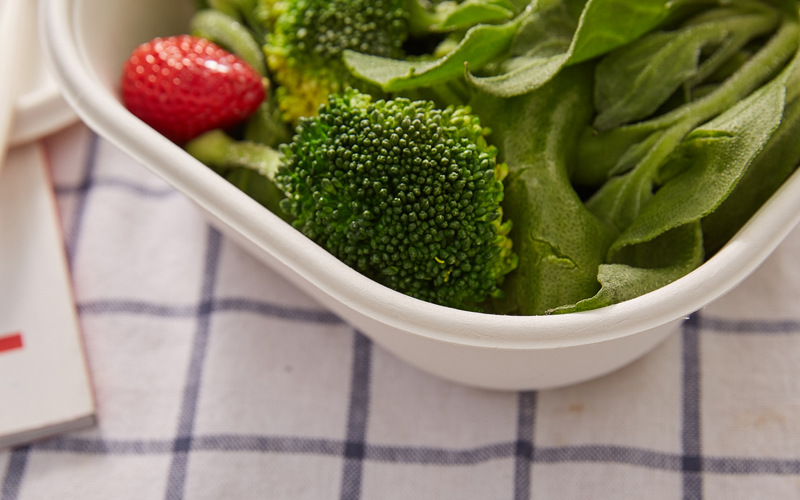
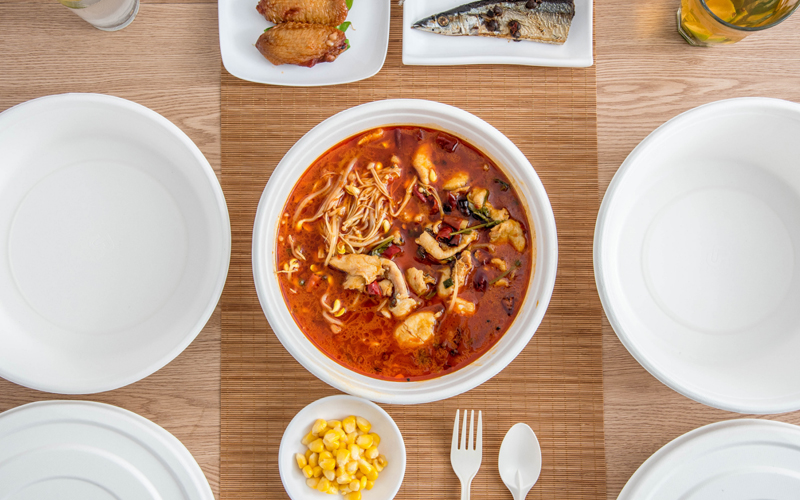
Bagasse bowls are used across many foodservice applications, including salads, grain bowls, noodles and selected hot-food meals.
However, different menus place different demands on the container.
A cold salad with dressing may require a different closure system from hot noodles with broth.
Bowl capacity also deserves attention.
A nominally rated bowl may not provide the same usable volume once the required headspace and lid are taken into account.
When selecting bagasse bowls, compare the intended serving volume, food type and compatible lid rather than relying on capacity alone.
For detailed compatibility checks, read Warmpack's bagasse bowl and lid guide.
Bagasse Trays and Clamshell Containers
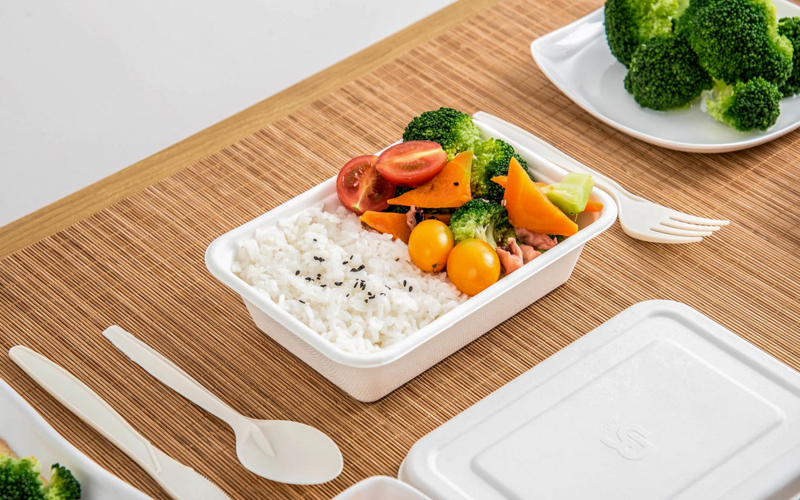
Bagasse trays can support ready meals, catering, food displays and other serving applications.
Some trays are designed for open presentation. Others are paired with lids or sealing films for takeaway, distribution or retail use.
Hinged clamshell containers combine a base and lid in one folding structure.
They are widely considered for takeaway meals, burgers, rice dishes and other prepared foods.
But closure performance depends on the exact design.
A container that closes correctly when empty may behave differently after filling with hot food or being stacked for delivery.
Buyers should compare bagasse trays and compostable clamshell containers according to the intended use.
Foodservice Application Comparison
Product Type | Typical Application | What Buyers Should Verify |
Bagasse plate | Catering, events, meal service | Size, rigidity, portion loading |
Bagasse bowl | Salads, rice, noodles, soups | Usable volume, liquid exposure, lid fit |
Food tray | Ready meals, serving, food displays | Dimensions, stacking, barrier and sealing compatibility |
Clamshell container | Takeaway and food delivery | Closure, food fit, transport performance |
Bagasse cup lid | Beverage service | Cup-rim compatibility, temperature and fit |
These applications describe common use cases, not universal performance guarantees.
What the Material Name Does Not Prove
Heat, Oil and Moisture Performance
Bagasse is a fiber material. The finished container's resistance to heat, moisture and oil depends on its construction.
Two containers made primarily from sugarcane fiber may behave differently when exposed to hot sauces or oily meals.
Fiber distribution, forming quality, surface treatments, coating materials and contact time can affect performance.
Therefore, describing a product as bagasse does not automatically mean it is microwave-safe, oven-safe, freezer-safe or leakproof.
Each claim needs supporting product-specific information and, where appropriate, application testing.
For more demanding menus, buyers should review the complete container structure rather than selecting products solely by their environmental description.
Food-Contact and Chemical Claims
A natural agricultural origin does not automatically establish food-contact compliance.
Finished foodservice packaging must be evaluated against the applicable requirements of its destination market and intended use.
That may involve documentation concerning the fiber, additives, coatings, adhesives, printing and other relevant components.
The same principle applies to PFAS-related claims.
A supplier declaration or laboratory result should be connected to the specific product or formulation being purchased.
Warmpack's certificate information provides a starting point for document discussions. Buyers should confirm the applicable scope for their chosen SKUs.
What Are the Advantages of Bagasse Packaging?
One important advantage of bagasse is its use of an agricultural byproduct as a fiber source.
Molded-fiber processing also supports a variety of container shapes, including plates, bowls, trays and compartmented food packaging.
For foodservice businesses, product diversity can help simplify the selection of packaging within a common material family.
The final benefits, however, depend on the product and its application.
Strength, stacking, performance, material use and environmental outcomes should be assessed using relevant specifications and evidence.
For a deeper discussion of purchasing and application advantages, see Warmpack's updated article on the advantages of bagasse packaging.
This introductory guide focuses instead on the material's origin, processing and uses.
Can Bagasse Packaging Be Composted or Recycled?
The disposal route depends on the finished product and the local waste-management system.
An unlined fiber product may be suitable for a particular composting program, but acceptance is not universal.
Coatings, adhesives, labels and other components can affect whether the complete packaging item meets a compostability requirement.
Certification and local acceptance are also separate questions.
A certified product may still be excluded by a particular commercial composter.
For a practical verification process, consult Warmpack's commercial composter acceptance guide.
Recycling requires similar caution.
Food contamination, barrier layers and the policies of local collection systems or paper mills may prevent some used packaging from entering a conventional fiber-recycling stream.
The safest approach is to verify the exact finished product and the available local disposal route before making a consumer-facing environmental claim.
What Should Buyers Check Before Ordering Bagasse Products?
Understanding bagasse as a material is useful, but bulk purchasing requires product-level verification.
Start by identifying the intended application and choosing the relevant container category.
Then record the product code, dimensions, usable capacity, material construction, lid requirements and packing specification.
Ask for supporting documents relevant to the destination market and the claims you intend to make.
Next, request samples and test them with actual food under realistic service conditions.
A sample that performs well in a brief visual inspection may still need further testing for hot food, liquid exposure, stacking or transport.
Warmpack's sample testing guide explains how to evaluate candidate containers before supplier approval.
The key is to approve a specific product—not just a material category.
Frequently Asked Questions
1. What Is Bagasse Made From?
Bagasse is the fibrous material remaining after sugarcane juice is extracted. Its plant-fiber composition makes it useful for pulp production and molded-fiber applications.
2. Is Bagasse the Same as Paper?
Not exactly. Bagasse is a source of plant fiber, while paper describes a finished material produced through papermaking. Bagasse fiber can be used in certain paper products and molded-fiber packaging.
3. How Is Bagasse Turned Into Food Packaging?
Bagasse is cleaned, processed into pulp, formed into molds and dried or pressed. Finished products may also undergo trimming, inspection and additional treatments, depending on their design.
4. What Food Containers Can Be Made From Bagasse?
Common molded-fiber formats include plates, bowls, meal trays, hinged clamshells and selected lids. The appropriate shape depends on the foodservice application.
5. Is Bagasse Packaging Always Compostable?
No universal conclusion should be drawn from the fiber name alone. The complete product construction, applicable certification requirements and local composting facility acceptance must all be considered.
6. Can Bagasse Containers Go in a Microwave?
Only when the specific finished product is suitable for the intended microwave conditions. The presence of sugarcane fiber does not establish the suitability of every coating, lid or adhesive.
7. Does Bagasse Packaging Contain PFAS?
The material name does not answer that question. Buyers should obtain relevant formulation declarations or testing information for the finished product and confirm which SKU or production scope the evidence covers.
8. How Should Importers Choose a Bagasse Packaging Supplier?
Evaluate the supplier's product range, manufacturing responsibility, specifications, documentation, samples, quality controls and commercial terms. Compare specific approved products rather than relying on general material claims.
Explore Bagasse Packaging With Warmpack
Bagasse begins as a sugarcane-processing byproduct, but its commercial value comes from how that fiber is converted into functional products.
For buyers, understanding the material is the first step. Choosing a suitable finished container requires matching its design and documentation to the actual application.
Warmpack provides a range of molded-fiber foodservice packaging, including plates, bowls, trays and takeaway containers.
Tell our team your target product category, food application, destination market, required dimensions and estimated purchasing quantities.
Contact Warmpack to discuss available specifications, suitable product options and sample requirements.