


Bagasse will not replace all plastics, but it is already replacing a meaningful share of single-use plastic in foodservice and ready-meal packaging. The winning approach is “right material, right job”: use molded fiber where stiffness, heat tolerance, and a clearer end-of-life path matter—keep plastics for extreme moisture/temperature or reusable systems.
Why bagasse has momentum: policy and sustainability advantages
Regulatory pressure is reshaping packaging choices. Single-use plastic restrictions, Extended Producer Responsibility (EPR) fees, recycled-content mandates, and increasing PFAS scrutiny all point brands toward lower-plastic, fiber-forward formats when functionality matches the job. Bagasse valorizes sugarcane residue, reducing dependence on virgin petrochemicals and helping brands align with sustainability commitments and LCA goals.
What is bagasse (sugarcane fiber)


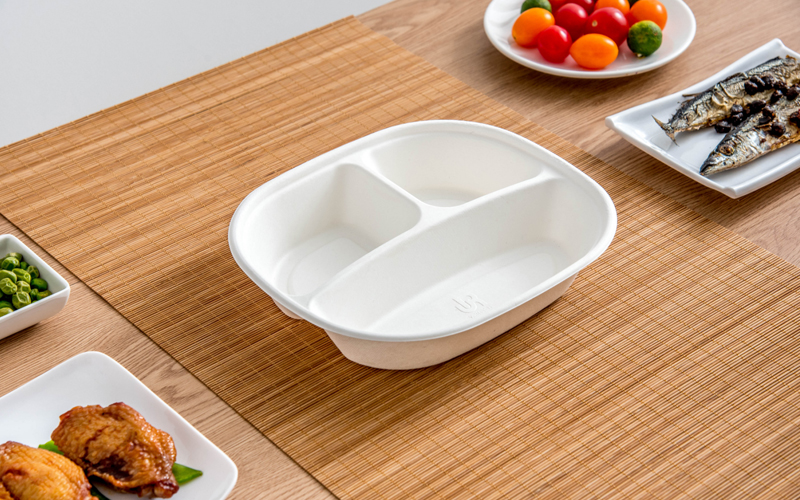
Bagasse is the fibrous residue left after sugarcane juice extraction. Once cleaned and pulped into slurry, it can be vacuum-formed and hot-pressed into rigid, smooth-rimmed containers. The result is molded fiber tableware that feels sturdy in hand, stacks neatly, and presents cleanly on shelf.
How molded-fiber packaging is made
Fiber slurry is formed on tooling, then hot-pressed with matched molds to densify walls and define seal-ready rims. After demolding, parts are trimmed, edge-finished, and dust-cleaned—key to sealing consistency and retail presentation.
Unlined vs film-lined (PLA/PBS/PE)
Unlined fiber suits most menus and simplifies end-of-life claims. Film-lined bowls and trays add oil/water barrier and tighter heat-seal control for oily or long-hold dishes, long delivery windows, high-condensation chillers, or automated lidding lines.
Where bagasse outperforms plastics in single-use formats


Stiffness and hand-feel
Molded fiber walls are rigid enough for one-hand carries, reducing lid pop-off and tray flex.
Heat tolerance for everyday service
Conservative use covers hot-fill near ~100 °C, short microwave cycles with venting, and freezer storage around −18 °C.
Retail-ready display
Smooth rims and natural surfaces pair well with PET/PP clear lids or anti-fog, easy-peel heat-seal films—ideal for deli, salad, chilled entrées, and meal kits.
End-of-life messaging
Unlined fiber can fit industrial composting where facilities exist, providing a clearer story than “wish-cycling” contaminated plastics. Film-lined items require market-specific evaluation.
Where plastics still dominate
Extreme wet/grease and prolonged holds
Hours-long hot oil or acidic soaks fatigue unlined fiber; films help but may constrain end-of-life options.
High-temperature processing and reusables
Retort/aseptic, repeated dishwashing, and oven cycles usually favor engineered plastics, metals, or glass.
Ultra-thin high-barrier flexibles
When barrier and thickness targets are extreme, plastics remain the primary option.
Regulatory drivers you can’t ignore
Single-use plastic bans and restrictions
Straws, cutlery, and hinged containers face mounting limits; fiber formats often become the default where function is equivalent.
EPR and eco-modulated fees
Fees tied to material choices push designs with lower plastic content and clearer disposal pathways.
Chemicals management (PFAS scrutiny)
Buyers increasingly require SKU-level PFAS status and food-contact documentation (FDA/LFGB/EU 1935/2004). Mature bagasse suppliers provide the paperwork needed for audits and listings.
Core food packaging applications (SEO-friendly)
Bagasse plates, bowls, trays and clamshells
Takeout and ready meals benefit from molded fiber’s stiffness and presentation. Typical keyword targets include bagasse plates, compostable bagasse bowls, bagasse trays, bagasse clamshells, and compostable cup lids.
Selecting structures: a simple decision tree
Choose unlined when
Menus are moderate in oil/water, routes are short, and industrial composting access exists.
Choose film-lined (PLA/PBS/PE) when
Dishes are oily/saucy, routes run 45–90 minutes, chillers cycle condensation, or you need tight peel strength on automated sealers.
Seal systems and line validation
Define seal temperature/time/pressure, choose an easy-peel anti-fog film if needed, and validate peel at cold/ambient/hot. Confirm that lids/films match rim geometry and that line speed doesn’t compromise sealing.
Thermal and cold-chain guidance
Follow conservative use: hot-fill near ~100 °C, microwave at 50–70% power in short, vented cycles, short oven reheats on a sheet pan, and avoid direct flame/stovetops. Freezer stability is typically around −18 °C.
End-of-life reality check
Industrial composting access varies by region. Food-soiled fiber rarely suits paper recycling streams. For film-lined SKUs, end-of-life depends on laminate type and local infrastructure—claims must reflect local acceptance.
Quality and durability tests to run before scale
Peel/leak at cold/ambient/hot, stack compression and burst, drop and route-vibration, condensation cycling in chillers, and quick sensory checks (sniff and hot-fill) on your most aromatic recipes.
Cost and scale: design and process matter
Cost is shaped by fiber yield, energy, and scrap rates—kept in check by digital process control (slurry consistency/pH, press temperature/pressure, rim height, weight targets) and robust AQL/QA programs. Export-ready pallet patterns and container loading plans stabilize landed cost.
Why choose Warmpack
Warmpack manufactures molded-fiber tableware—bagasse plates, compostable bagasse bowls, trays, clamshells, and cup lids—with OEM/ODM support and wholesale supply. Options include unlined or film-lined (PLA/PBS/PE), PET/PP lids, and anti-fog, easy-peel heat-seal films. Each SKU can be supported with PFAS status and food-contact documentation (FDA/LFGB/EU 1935/2004). Factory-direct pricing, predictable lead times, and export-optimized pallets make switching and scaling straightforward.
FAQs
Microwave?
Short cycles at 50–70% power with venting.Oven?
Short reheats only.Heat-seal?
Yes—match rims/films and validate peel across temperatures.Compostable?
Unlined molded fiber typically fits industrial composting where accepted.Samples?
Available for pilot validation.
Conclusion and next steps
Bagasse will not replace plastics everywhere—but in single-use food packaging it is a proven, scalable alternative backed by policy tailwinds and strong consumer acceptance. Shortlist bagasse for plates, bowls, trays, clamshells, and lids; validate seals and routes; align end-of-life claims with local infrastructure; then scale with Warmpack as your manufacturing partner.


