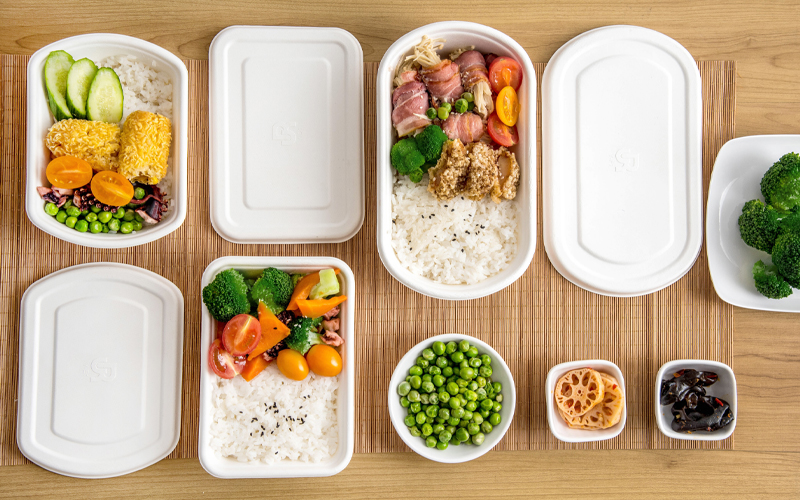
Bagasse food packaging is molded-fiber packaging made using the fibrous residue left after sugarcane juice extraction. It is formed into products such as plates, bowls, trays and hinged food boxes. For a buyer, the useful question is how a particular finished product fits the food, service process and disposal arrangements it will encounter.
Use this guide to identify the product family and the information needed for a sample request. A material name alone does not establish the performance, composition or certification of every container sold under that name.
What Is Bagasse Food Packaging Made From?
From Sugarcane Residue to Molded Fiber
Manufacturers process fiber into pulp, form it into the required shape, and dry and finish the molded part. Product geometry, processing and finishing influence dimensions, stiffness and rim consistency. These features need to be checked on the selected product and production specification.
Keep a short material description in the purchasing record, together with the supplier's product code and drawing revision. If the supplied product uses a fiber blend, ask for that description rather than assuming the entire pack has one ingredient.
Fiber, Barriers and Separate Components
A finished pack may include a fiber base, a barrier treatment, a separate lid, a film, printing or labels. Identify each component before evaluating the complete pack. A lid that looks compatible still needs a confirmed model and rim match.
For barrier choices, use the bagasse coatings guide. The material description should match the actual quoted configuration; a general description of sugarcane fiber cannot establish that every component is plastic-free or additive-free.
Which Bagasse Packaging Format Fits Your Menu?
Start with the food and serving process, then shortlist formats. Catalog names and nominal sizes help navigation, but the filled sample determines whether the meal fits and can be handled as intended.
| Format | Buying question | What to confirm on the sample |
| Plate or open tray | Will the portion sit securely during serving? | Usable area, rim shape and handling with the actual meal |
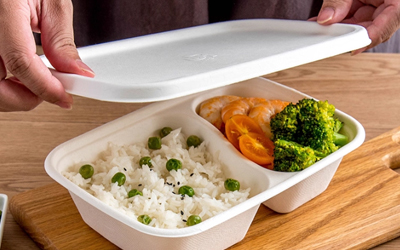
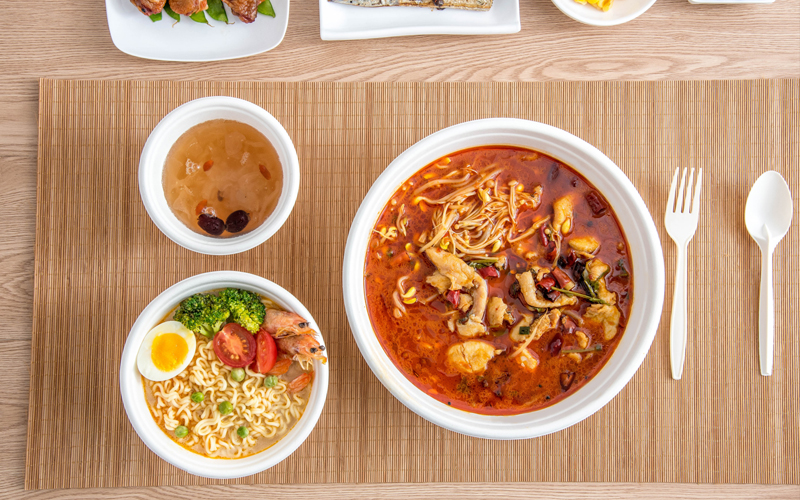
| Bowl with separate lid | Does the complete combination suit filling and delivery? | Usable fill level, headspace, lid model and closure retention |
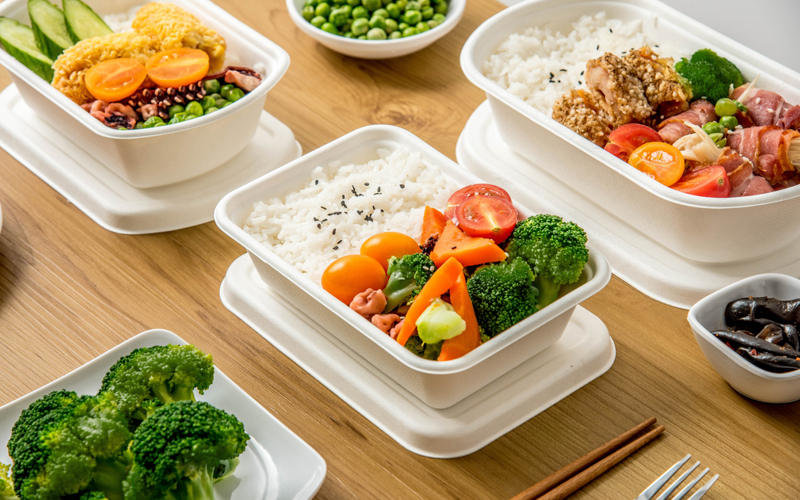
| Hinged clamshell | Can staff close and transport the normal meal? | Closed dimensions, locking tabs, compartments and route performance |
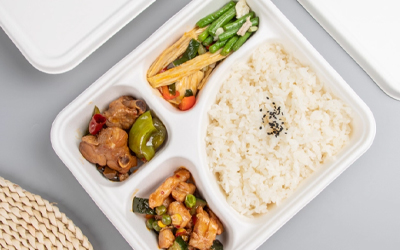
| Compartment tray | Do the meal components fit their intended wells? | Individual usable areas, food height and sauce movement |
Browse the bagasse plate range or bagasse clamshell range. For clamshell dimensions, use the existing size and packing guide. Confirm current specifications before transferring catalog information into a purchase order.
![White bagasse bowls holding noodles and soup on a bamboo placemat]()
What Are the Practical Benefits—and Limits?
Structure and Handling
Molded formats give buyers a way to specify shape, compartments and serving layout. Whether a format improves handling depends on the particular design, the food load and the operating process. Compare samples with the same meal and portion instead of treating the material name as a performance guarantee.
![Square bagasse food boxes holding rice and vegetables with separate lids]()
Food Exposure and Service Time
Record the food, filling conditions, holding period, delivery route and any reheating or freezing requirements. Moisture, oil, sauces, stacking and closure can present different demands. A product approved for one service process should not automatically be approved for a different process.
Use the food-container testing guide to organise checks. Confirm any microwave, freezer or oven instruction for the exact base, lid and other components. Do not apply a temperature or time from an unrelated product.
How Should Buyers Check Environmental Claims?
Check the Finished-Product Scope
Ask which supplied item and configuration an environmental claim covers. Where certification is claimed, match the product identification and scope to the relevant record. A certificate for one item does not, by itself, establish coverage for an entire range or for a different lid, coating or colour.
For a BPI claim, buyers can consult the BPI certified-product catalog guidance. It distinguishes commercially compostable listings from items that also hold home-compostability certification. Do not infer home-compostability status from a commercial listing.
Check Collection and Local Acceptance
Before writing disposal instructions, confirm the collection arrangements and acceptance rules of the intended facility. Avoid promising that all bagasse packs compost at home, are accepted everywhere or disappear within one fixed number of days.
The FTC's Green Guides summary explains why compostability claims require supporting evidence and appropriate qualifications. Product evidence and the intended disposal route should be considered together when preparing market-facing wording.
![Oval and rectangular bagasse lunch boxes with rice, vegetables and separate lids]()
What Should You Confirm Before a Bulk Order?
Compare the Product and Packing on the Same Basis
Send each supplier the same requirement. Separate pieces, complete sets, inner packs and cartons so quotations refer to the same purchasing unit. Compare dated packing records and delivery terms before drawing a cost conclusion.
| Field | Information to request | How it supports the decision |
| Product identity | SKU, configuration and drawing revision | Connects the quote, sample and ordered item |
| Food and service | Menu, portion, fill conditions, hold and route | Defines the sample-evaluation task |
| Packing | Pieces per pack/carton, carton dimensions with units and gross weight | Supports freight and warehouse planning |
| Order basis | Quantity by SKU, minimums, delivery destination and quote validity | Makes quotations comparable |
| Documents | Required market, product scope, report conditions and validity where applicable | Identifies what evidence still needs review |
Use the price and landed-cost guide for the cost framework and the mixed-SKU loading guide for packing questions. Actual minimum quantities, packing and lead times require confirmation for the proposed order.
Keep Sample Approval and Batch Checks Connected
Record the agreed sample, acceptance criteria and unresolved questions. Blank customer worksheets are intended for completion during the project; they are not evidence of completed tests. Connect the approved specification to the bulk-order QC checklist and review relevant changes before repeat orders.
Request a Product-Specific Sample Review
Send your selected product or menu brief, portion, filling and delivery conditions, quantity by model, destination and document requirements. Ask Warmpack to confirm the proposed configuration, current packing, available documents and sample plan before quotation approval.
Contact Warmpack about samples and a wholesale quotation.
Buyer FAQs
1. Is bagasse food packaging the same as paper packaging?
Bagasse identifies the sugarcane-derived fiber source. Check the finished product's fiber description and construction when comparing it with paperboard or other molded-fiber products.
2. Does bagasse mean that the complete pack is plastic-free?
No such conclusion follows from the base material alone. Confirm barriers, lids, films, labels and other components for the quoted configuration.
3. Can I use any lid with a bowl of the same stated diameter?
Confirm the exact bowl-and-lid pairing. Nominal diameter does not establish compatible rim geometry or reliable closure after filling and handling.
4. Is every bagasse container suitable for soup or long holding periods?
Ask for a configuration suited to the intended food and service conditions, then test it. A general material description does not establish suitability for those conditions.
5. Can the container go in a microwave or oven?
Follow the instructions and supporting information for the exact base and lid. Do not apply an unrelated product's rating or assume the same instruction covers both appliances.
6. Does commercial compostability also mean home compostability?
Check the specific certification scope. Commercial and home compostability are separate claims; confirm facility acceptance as well as product coverage.
7. Does a compostability certificate prove food-contact suitability?
Request the food-contact evidence separately and match it to the intended food and use conditions. Keep the two evidence questions distinct.
8. What should appear in a useful wholesale quote request?
Include SKU or menu, quantity by model, component requirements, packing, destination, timing and document needs. Ask the supplier to identify assumptions and exclusions.
9. Can several SKUs share one minimum order quantity?
Ask for written minimums for each line and for the mixed order. Do not assume that one total order quantity satisfies every production or packing requirement.
10. What information makes a repeat order easier to control?
Keep the approved drawing, configuration, sample reference, packing record and acceptance criteria together. Identify changes that need review before the next batch is accepted.