You are here:Home » Blog » Canton Fair 2026: A Bagasse Tableware Sourcing Guide for Buyers
Canton Fair 2026: A Bagasse Tableware Sourcing Guide for Buyers
Views: 0 Author: warmpack Publish Time: 2026-09-11 Origin: Site
How Importers and Distributors Can Verify Exhibitors, Compare Products and Turn Supplier Meetings Into Actionable RFQs
Last verified: October 20, 2026 | 140th Canton Fair, Autumn 2026
Quick Answer: Which Canton Fair Phase Should Bagasse Tableware Buyers Visit?
If you're sourcing bagasse plates, bowls, takeaway containers or other molded-fiber tableware at the 140th Canton Fair, start with Phase 2, October 23–27, 2026.
The official fair schedule places Kitchenware and Tableware in Phase 2. Phase 1 has already concluded, while Phase 3 runs from October 31 to November 4.
However, an exhibition category doesn't guarantee that a particular bagasse packaging manufacturer will be present.
Before arranging a meeting, check the company's current exhibitor listing, confirm its legal entity and verify its booth information through official channels.
Your objective is not simply to collect supplier catalogs. It's to leave with identifiable product samples, relevant technical documents and quotations that can be compared on the same basis.
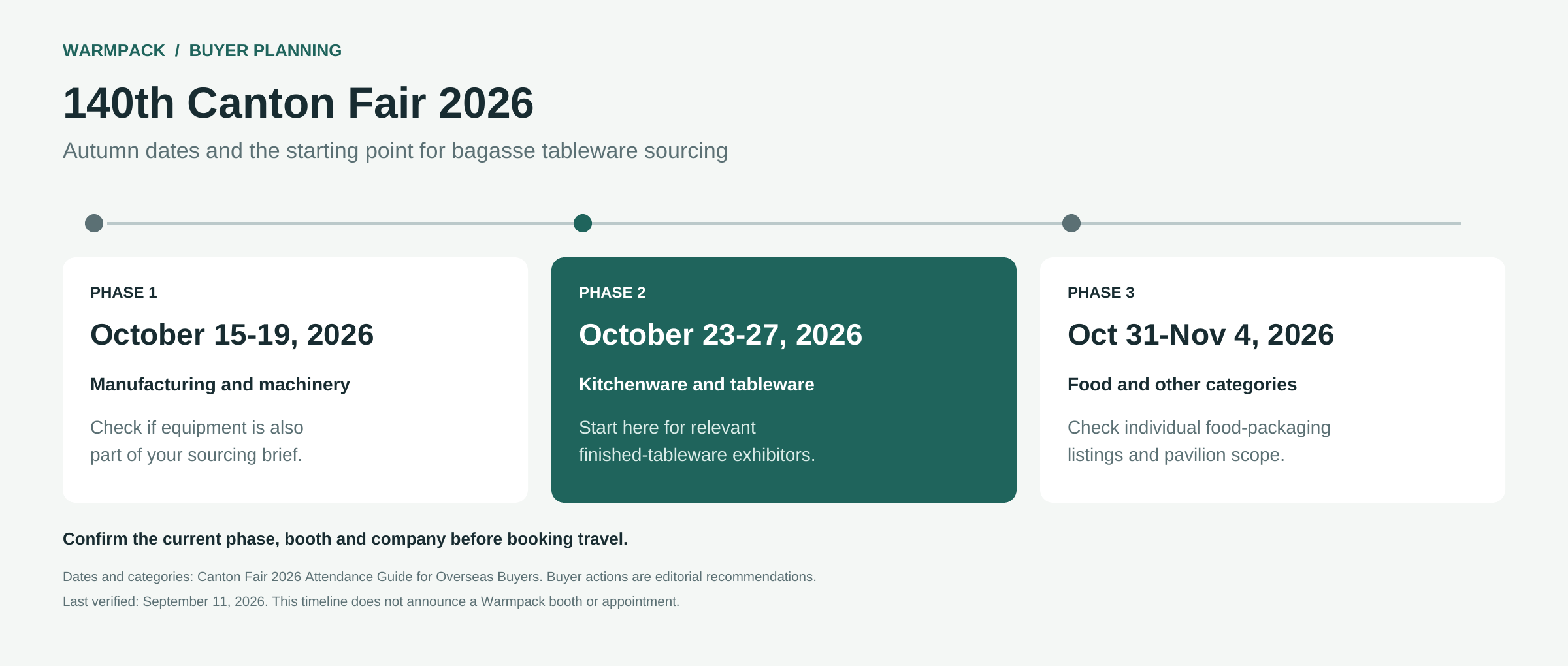
Official 140th Canton Fair Schedule
Phase
Dates
Relevant Categories
Buyer Priority
Phase 1
October 15–19, 2026
Manufacturing and machinery
Completed; relevant to equipment buyers
Phase 2
October 23–27, 2026
Kitchenware and Tableware, Household Items
Main starting point for tableware sourcing
Phase 3
October 31–November 4, 2026
Food and other product categories
Check specific food-packaging and pavilion listings
The official Phase 2 layout identifies Kitchenware and Tableware in Area A, including halls 1.2, 2.2, 3.2, 4.2 and 5.2, alongside mezzanine sections. This helps buyers plan their route but does not identify which individual supplier occupies a specific booth.
Original planning graphic prepared September 11, 2026; dates rechecked October 20, 2026.
How to Find and Verify Relevant Bagasse Tableware Exhibitors
Start With the Current Exhibitors and Products Directory
The official Canton Fair website provides Exhibitors + Products search, a Buyer Guide and exhibition layout information for the 140th edition.
Search using several combinations rather than relying on a single keyword:
Bagasse tableware or sugarcane tableware
Molded fiber food packaging
Compostable plates and bowls
Biodegradable takeaway containers
A specific supplier's registered company name
Different descriptions may lead to different exhibitors. A company selling molded-fiber products may not use the word bagasse in every listing.
Kitchenware and Tableware is the primary section to investigate. Household Items may provide additional leads, but buyers should verify individual exhibitors instead of assuming every household-products supplier offers food-contact packaging.
What an Exhibitor Listing Actually Proves
An exhibitor listing can help identify a company and its advertised products.
It does not automatically prove that the company owns its factory, manufactures every displayed SKU, holds certification for every product or has production capacity available for your order.
Ask four questions:
1. Which legal entity appears on the quotation and export documents?
2. Where is the selected product actually manufactured?
3. Who holds the relevant product documentation?
4. Which company will be contractually responsible for your order?
These distinctions matter when comparing manufacturers, trading companies and integrated supply businesses.
A trading company may be a suitable partner, but its responsibilities should be transparent. Conversely, a factory's general production capability does not prove that a specific SKU is produced in-house.
Create a Pre-Fair Supplier Shortlist
Prepare a simple record before visiting the exhibition:
Candidate
Target Product
Legal Entity
Current Booth
Documents to Review
Next Action
Supplier A
9-inch bagasse plate
To verify
To verify
Specification, product reports
Confirm appointment
Supplier B
750 ml bowl and lid
To verify
To verify
Bowl/lid drawings, compliance scope
Request samples
Supplier C
3-compartment meal tray
To verify
To verify
SKU specification, packing data
Request quotation
These are illustrative sourcing records, not confirmed exhibitors.
If the current booth cannot be verified, contact the company through its normal business channels. Never rely on a previous year's booth photograph or exhibition number as current evidence.
Prepare One Comparable Sourcing Brief Before the Fair
Define the Food Application First
Tell suppliers what the packaging must actually do.
A bagasse plate for dry bakery items, a clamshell for burgers and a tray for hot curry have different performance requirements.
Describe the food type, portion size, filling temperature, expected holding time and transport conditions.
If your product will require a lid, include that requirement from the beginning.
For example, when comparing bagasse bowls, the usable fill volume and closure configuration may be more important than the nominal capacity shown in a catalog.
Define the Product and Commercial Requirements
Give each supplier the same basic information:
Product type, dimensions, capacity and number of compartments.
Fiber construction, coating preference and color.
Lid or sealing-film requirements.
Destination country and required supporting documents.
Initial order quantity and estimated annual demand.
Packing quantity, shipping terms and target delivery schedule.
Separate essential requirements from optional preferences.
If a PET lid is mandatory for product visibility, it should not be silently substituted with a fiber lid. If the carton printing color is negotiable, suppliers can offer alternatives.
The annual forecast should be labeled as an estimate, not a confirmed purchase order.
A 15-Minute Supplier Meeting Workflow
A short meeting can produce useful information when every question has a purpose.
Minutes 0–3: Confirm the Company and Product Scope
Confirm the company name, business role, production location and product categories.
Ask whether the selected SKU is manufactured at the supplier's own facility or sourced from another producer.
Minutes 3–7: Inspect and Label the Sample
Examine the actual product.
Check visible defects, edge finishing, rigidity, stacking, lid engagement and basic dimensional consistency.
Record the SKU, mold reference if available, lid code and sample origin.
One useful question is: Is this a normal production sample, a development sample or an exhibition display sample?
Take photographs of the product together with its identifying label, subject to the exhibitor's permission.
Minutes 7–11: Match Claims to Supporting Documents
Ask which supporting documents apply to the selected product.
For food-contact requirements, check the product construction, intended food type, temperature conditions and destination market.
For compostability, record the certification scheme, certificate scope and exact product configuration.
If the supplier makes a PFAS-related declaration, distinguish formulation information from laboratory test results.
Minutes 11–15: Confirm the Quotation and Next Steps
Before leaving, confirm who will provide the quotation, product drawings, documentation and samples.
Agree on a response date and record any missing information.
Keep the supplier contact, product code, sample source, outstanding questions and follow-up owner together.
This turns a brief discussion into a usable procurement record.
What Can Be Checked at the Booth—and What Requires Further Testing?
Use On-Site Checks for Initial Screening
Physical inspection can identify obvious differences between samples.
For example, a lid may be difficult to close, a corner may lift, or a tray may deform under light handling.
Record these observations precisely instead of using vague descriptions such as “good quality” or “strong material.”
A brief demonstration with water may provide useful initial information, but it cannot establish universal leak resistance or performance with hot, oily or acidic food.
Complete Food and Transport Testing After the Fair
Test shortlisted products with their intended contents and conditions.
Potential assessments include leakage, hot-food holding, oil exposure, condensation, lid compatibility, stacking and transport movement.
A display sample should not automatically become the mass-production standard.
Approve a documented reference sample and the associated product specification before releasing production.
Match Supplier Claims to Evidence
Supplier Claim
Initial Evidence
Follow-Up Requirement
Direct manufacturer
Company and factory details
Verify producing entity and SKU production scope
Food-contact suitability
Relevant report reference
Check complete report, use conditions and target market
Compostability
Certificate number
Verify exact product and certification scope
PFAS-related claim
Declaration or test reference
Review formulation or tested-sample applicability
Production capacity
Equipment and product-family information
Confirm available scheduling for the order
Product durability
Physical sample
Run application-specific testing
A certificate issued for a raw material should not automatically be presented as certification of the finished container.
Similarly, food-contact documentation must be assessed against the relevant materials, construction and intended use.
If you are planning to collect used containers through a commercial composting program, consult Warmpack's commercial composter acceptance guide. Certification and local facility acceptance are separate checks.
Turn Booth Notes Into Comparable RFQs
Identify the Exact Product Configuration
Use one record for each product and component combination.
A bowl base and matching lid should have separate codes when applicable. Specify internal versus external dimensions and nominal versus usable capacity.
If a supplier proposes a different weight, coating, rim design or carton quantity, record the change as an alternative.
Do not quietly replace the original specification.
Separate Product, Lid, Packaging and Customization Costs
A quotation should specify whether the unit price includes the base, matching lid, printed packaging and other required components.
For customized projects, ask whether tooling, embossing, printed bags or retail boxes have separate minimum quantities and setup charges.
Compare quotations only when the specification, order quantity and delivery basis are consistent.
Check the price unit, currency, MOQ, carton quantity, freight responsibility, quoted Incoterms rule, named location, validity period and excluded charges.
Do not approve a large-volume order merely because the exhibition meeting went well.
Frequently Asked Questions
1. Which Phase of Canton Fair 2026 Should Bagasse Tableware Buyers Visit?
Phase 2, October 23–27, is the primary starting point because it includes Kitchenware and Tableware. However, confirm each target exhibitor's participation and current booth details separately.
2. Does a Product Category Listing Confirm a Supplier's Current Booth?
No. A category identifies an exhibition section, not a particular supplier's location. Verify the current exhibitor record and obtain direct confirmation before arranging a meeting.
3. Does Exhibiting at Canton Fair Prove That a Supplier Is a Manufacturer?
No. A listing alone does not establish factory ownership or in-house production of a particular SKU. Check the legal entity, production location and product documentation.
4. What Should Buyers Bring to a Supplier Meeting?
Bring a written sourcing brief, current packaging sample, drawings or dimensions, menu information, expected quantities, destination-market requirements and sample deadlines.
5. Can Food-Contact and Compostability Claims Be Approved at the Booth?
Booth discussions can identify documents for further review. Final approval requires checking the complete evidence against the exact product, construction, intended use and destination-market requirements.
6. How Should Buyers Record Samples and Documents?
Assign each sample a unique identifier. Record its supplier, SKU, component configuration, photograph and corresponding document references. Keep these linked through quotation and product approval.
7. What if a Supplier's Booth Cannot Be Confirmed Before Travel?
Check the official Canton Fair directory and contact the supplier through its established business channels. Avoid making travel plans based solely on outdated exhibition information.
8. Can Buyers Work With Warmpack Without Meeting at the Fair?
Yes. Buyers can contact Warmpack to request product information, discuss sample requirements and obtain project-specific quotations. Availability, documentation and commercial terms should be confirmed for the selected items.
Work With Warmpack Before or After Canton Fair
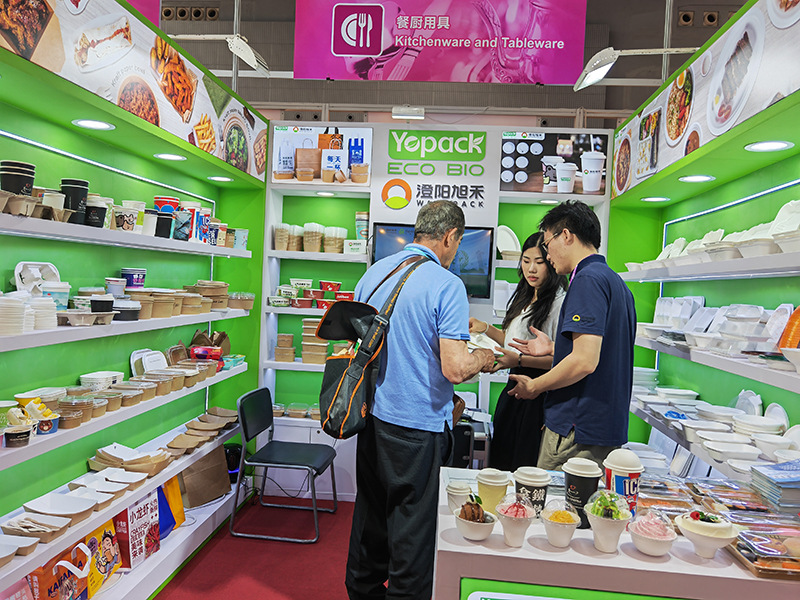
Warmpack at Canton Fair, 2025 — historical photo
A successful sourcing visit should give your purchasing team more than business cards.
You need identifiable products, comparable quotations, relevant documentation and a clear sample approval plan.
Warmpack supplies a range of bagasse plates, bagasse trays, bowls and takeaway packaging for foodservice applications.
If you're evaluating a new packaging supplier, send Warmpack your desired product type, dimensions, food application, destination market, estimated quantity and supporting-document requirements.
Contact Warmpack to discuss product matching, specifications and sample options.
Whether you're attending Canton Fair or sourcing remotely, the same principle applies: verify the product, compare the complete offer and approve the evidence before placing your order.